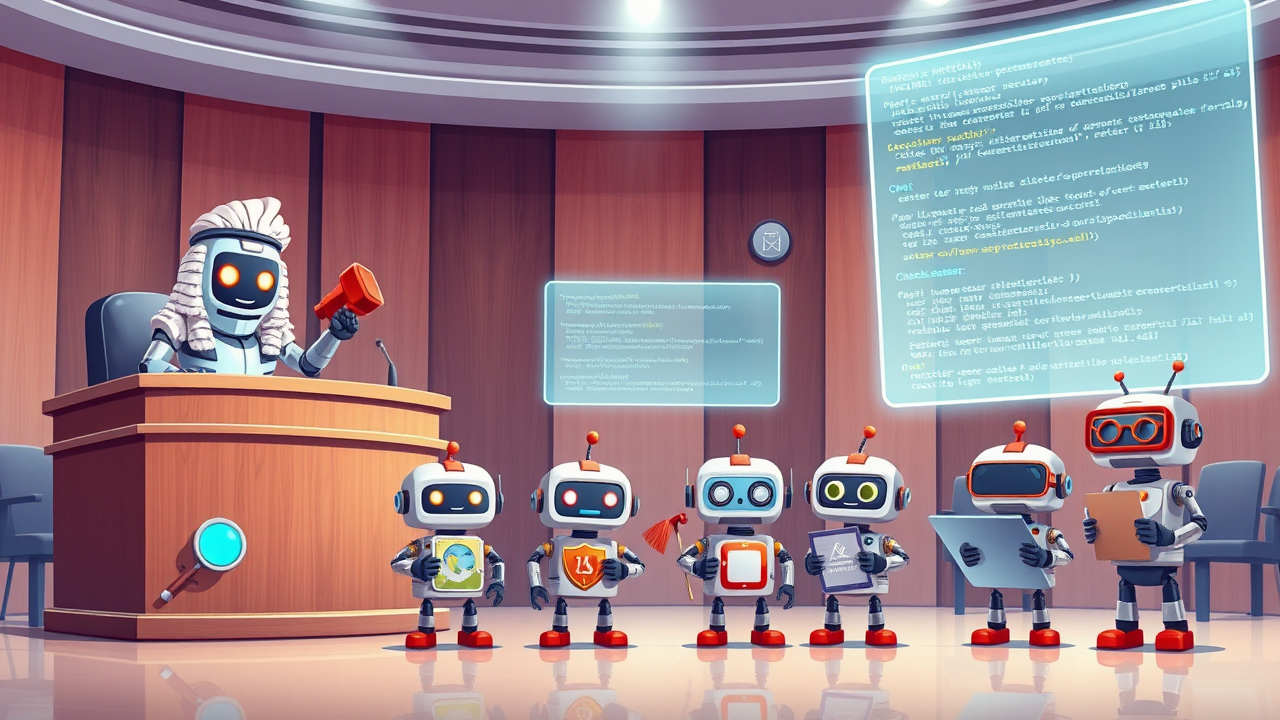
TL;DR: Single-agent AI review misses bugs because one perspective has blind spots. Multi-agent review uses specialized roles (Correctness, Challenger, Security, Edge Hunter, Simplifier, Reference, Judge) to catch more issues. The Judge synthesizes output so humans get actionable feedback, not noise.
You’ve probably used Copilot, ChatGPT, or Claude to review your code. Ask for feedback, get suggestions.
But here’s the uncomfortable truth: single-agent AI review is fundamentally limited. It’s like asking one teammate to review everything at once—they’ll give you their best perspective, but they won’t naturally shift between security, correctness, edge cases, and maintainability all at once.
You’ve probably seen feedback like this:
|
|
Helpful? Maybe. But did it catch the null pointer exception waiting to happen? Did it notice the SQL injection vulnerability? Did it question whether this function even needs to exist?
A single prompt can ask for all these things, but the agent naturally focuses on what seems most obvious—missing systematic checks.
The Seven Roles at a Glance
Before diving deep, here’s the structure: seven specialized roles that each approach code from a different angle:
- Correctness Reviewer — Does it do what it’s supposed to?
- Challenger — What assumptions could break?
- Reference Checker — Do the functions exist?
- Security Probe — Can this be exploited?
- Edge Hunter — What about boundary cases?
- Simplifier — Could this be simpler?
- Judge — Synthesize and prioritize
The Judge is key—it filters noise so humans get actionable feedback, not seven conflicting opinions.
What Is an “Agent” Exactly?
Before we go further, let’s clarify what I mean by “agent.” In this context:
An AI agent is a single LLM call with a specific system prompt and focus. Think of it like asking the same expert to wear different hats—you’re still talking to one person, but you’re directing their attention to specific things.
- Same model, different prompts: The underlying AI is the same; what changes is what you ask it to focus on.
- Not separate models: You don’t need Claude for security and GPT for correctness. One model can play multiple roles when prompted correctly.
- Runs in parallel or sequence: You can fire off multiple agent calls simultaneously (faster) or chain them (more context).
The Numbers on AI Code
Research from CodeRabbit (analyzing thousands of PRs in late 2025) found that AI-generated code has 1.75x more logic and correctness errors than human-written code. This has become a major issue for open source projects, which are being overloaded with low-quality AI-generated PRs.
According to Veracode research (September 2025, cited by Addy Osmani), 45% of AI-generated code contains security flaws—patterns like unvalidated inputs, missing boundary checks, and authentication gaps.
A single reviewer, whether human or AI, brings one mental model. That model has blind spots. And those blind spots are exactly where bugs hide.
The Multi-Agent Approach
Here’s a different way to think about code review: what if you had a team of specialists, each with a different focus?
Think of it like a code review where different team members naturally focus on different things. Your security-focused colleague immediately spots auth vulnerabilities. Your UX-minded teammate catches edge cases. Your senior architect questions assumptions.
The multi-agent approach replicates this by giving each AI agent a specific role:
- One asks: “Does this code do what it’s supposed to?”
- Another asks: “What happens when things go wrong?”
- A third asks: “Could someone exploit this?”
- A fourth asks: “Is there a simpler way?”
Each role has a clear mandate. Each brings a different lens. Together, they catch what any single perspective would miss.
Note: These aren’t different AI models—they’re the same model with different system prompts directing its attention. The specialization comes from how you ask, not what you ask.
Real-World Proof: HubSpot’s Judge Pattern
This isn’t theoretical. HubSpot built exactly this for their internal AI code review tool, Sidekick. They found that multiple reviewing agents generated useful feedback—but also a lot of noise. Engineers were drowning in suggestions, many of which contradicted each other.
Their solution? Add a Judge agent.
The Judge doesn’t review code itself. Instead, it synthesizes all the other agents’ feedback, filters out duplicates, resolves contradictions, and prioritizes what actually matters. The result: 90% faster time-to-first-feedback (from days to minutes) and 80% of engineers approving of the AI suggestions, compared to frustration with the unfiltered multi-agent output.
The key insight: multi-agent review produces better feedback through specialization and synthesis.
I arrived at this pattern independently while using multi-agent models for document review—adding a Judge to synthesize outputs significantly improved results. Later, I enriched the approach with insights from HubSpot’s engineering team and other practitioners who documented similar findings.
The Seven Roles of Effective Code Review
So what roles should your multi-agent review system include? Here’s a practical set that covers the major dimensions of code quality:
1. The Correctness Reviewer
Question: “Does this code do what it’s supposed to do?”
This is your baseline. Before worrying about edge cases or security, you need to verify intent. The Correctness Reviewer checks:
- Does the implementation match the requirements?
- Are the test cases covering the right scenarios?
- Is the logic sound for the happy path?
This role focuses on alignment—making sure the code solves the actual problem, not just a problem.
2. The Challenger
Question: “Challenge every assumption.”
The Challenger’s job is to be suspicious. Every assumption is an opportunity for bugs:
- “The API always returns 200—until it doesn’t.”
- “The user has permissions—until they don’t.”
- “This runs sequentially—until it doesn’t.”
This isn’t negativity—it’s surfacing hidden dependencies and fragile assumptions.
How it differs from Edge Hunter: The Challenger questions assumptions (external dependencies, permissions, execution order). The Edge Hunter tests inputs (null values, boundaries, edge cases). Different focus, different blind spots.
3. The Reference Checker
Question: “Does this function actually exist?”
This one sounds mundane until you’ve debugged a production issue caused by calling a function that doesn’t exist. The Reference Checker:
- Verifies imported modules exist and have the expected methods
- Checks that external APIs match their documented contracts
- Flags deprecated functions or changed signatures
It’s the detective work of code review—making sure the pieces actually fit together.
4. The Security Probe
Question: “Can this be exploited?”
Security flaws often hide in plain sight. The Security Probe agent hunts for:
- Injection vulnerabilities: SQL injection (malicious database queries), command injection (executing system commands), XSS (cross-site scripting in web apps)
- Authentication and authorization gaps: Can someone access data they shouldn’t? Can they escalate their privileges?
- Sensitive data exposure: Are passwords, API keys, or user data leaking into logs or error messages?
- Dependency vulnerabilities: Are you using outdated packages with known security issues?
This role requires paranoia as a feature, not a bug.
How it differs from Challenger and Edge Hunter: The Security Probe thinks like an attacker. The Challenger thinks about broken assumptions. The Edge Hunter thinks about unexpected inputs. Same code, three different mindsets.
5. The Edge Hunter
Question: “Hunt for boundary cases.”
Edge cases are where production incidents live. The Edge Hunter specializes in finding them:
- Empty/null values: When the array is empty, when the object is null
- Concurrent access: Two threads calling the same function simultaneously
- Boundary values: Maximum integers, empty strings, zero-length inputs, negative numbers
- Unicode and special characters: Emojis, non-ASCII text, extremely long strings
Every “this will never happen” is an incident waiting to occur.
6. The Simplifier
Question: “Could this be simpler?”
Complexity is a bug multiplier. The Simplifier asks:
- Is there a simpler algorithm?
- Can this abstraction be removed?
- Is this code doing too many things?
- Would a junior developer understand this in six months?
Sometimes the best code review comment is: “Delete this function, it’s not needed.”
7. The Judge
Question: “What matters most?”
The Judge doesn’t review code—it reviews reviewers. It:
- Synthesizes feedback from all other agents
- Removes duplicates and resolves contradictions
- Prioritizes by severity and impact
- Presents a coherent, actionable review
This is the HubSpot pattern in action. Without the Judge, you’d have to mentally juggle seven perspectives. With it, you get one focused review.
Modes for Different Needs
Not every code change needs the full treatment. A multi-agent system can adjust its depth based on context:
Quick Mode
Best for: Pre-commit sanity checks, minor changes, documentation updates
Runs the Correctness Reviewer only. Fast, focused, catches obvious issues before they reach the repo.
Verify Mode (Default)
Best for: CI/CD gates, feature branches, standard code reviews
Runs Correctness, Edge Hunter, and Reference Checker. The sweet spot for most day-to-day development.
Security Mode
Best for: Before deployment, authentication changes, data handling code
Runs Correctness, Security Probe, Edge Hunter, and Challenger. Use when you’re about to ship something sensitive.
Quality Mode
Best for: Refactoring, technical debt reduction, long-term maintenance
Runs Correctness, Simplifier, and Edge Hunter. Focuses on maintainability and complexity reduction.
Full Mode
Best for: Major PRs, critical paths, first-time contributors
Runs all seven roles. Comprehensive but slow—reserve for when it really matters.
The key is matching the review depth to the risk level. You don’t need a security audit on a README change.
Getting Started
If you’re convinced that multi-agent review is worth trying, here’s how to start:
Start with Correctness
Every review should begin with intent verification. Before checking edge cases or security, ask: “Does this solve the problem it’s supposed to solve?” Build this habit first.
Add Roles Based on Risk
A multi-agent system isn’t about running every check on every line of code. It’s about applying the right checks to the right code:
- Working on auth or payment processing? Add the Security Probe. This is high-risk code where security flaws have real consequences.
- Handling user input or external APIs? Add the Edge Hunter. This is where unexpected data causes crashes.
- Refactoring or reducing complexity? Add the Simplifier. This catches over-engineering before it spreads.
How to assess risk level:
- Does this code handle authentication or payments? → High risk, use Security or Full mode
- Does it process user input or external data? → Medium risk, use Verify mode
- Is it a small refactor or documentation change? → Low risk, Quick mode is fine
Match the review depth to the risk level.
Don’t Over-Engineer
Not every PR needs a seven-role review. If you’re fixing a typo in a config file, a single check is plenty. Save the comprehensive reviews for high-impact changes.
Focus on catching the issues that matter, not every possible issue.
This approach focuses on code review specifically, not design patterns—keeping scope manageable for beginners.
The Cost Question
Running seven agents sounds expensive. Is it?
Short answer: It costs more than one agent, but less than you’d think.
- Parallel execution: Most roles run simultaneously—latency is 2-3x, not 7x.
- Cost varies by mode: Quick mode costs the same as single-agent. Full mode costs more but only for critical code.
- Trade-off: One production bug can cost hours of debugging. Multi-agent review is cheap insurance.
How to Actually Build This
The concept is clear, but how do you implement it? Here’s what each role’s prompt looks like in practice:
Sample Prompts for Each Role
Correctness Reviewer:
|
|
Challenger:
|
|
Edge Hunter:
|
|
Security Probe:
|
|
Simplifier:
|
|
Judge:
|
|
Implementation Options
Simplest: Use your existing AI tool (Claude, ChatGPT, Gemini) with separate conversations for each role. Copy-paste the prompts above.
More integrated: Write a script that runs each prompt against your code and collects outputs. Most LLM APIs support system prompts—you’d run 5-6 calls and one synthesis call.
Production-ready: Use a framework like Claude Code, Pi, Opencode, or OpenClaw—all support system prompts. The prompts above work with any LLM; just copy them into your tool of choice.
Context Limits
For large codebases (2,000+ lines), not all agents need full context:
- Correctness Reviewer — requirements + changed files
- Reference Checker — imports and dependencies
- Edge Hunter — function signatures and inputs
- Security Probe — input handling and auth code
Most agents work on partial context. The Judge needs all outputs, but those are summaries, not full code.
What About Human Reviewers?
Multi-agent AI review isn’t replacing human reviewers—it’s augmenting them.
AI handles:
- Systematic checks (edge cases, security patterns, reference validation)
- Consistency enforcement (style, naming, patterns)
- First-pass filtering (catching obvious issues before humans see them)
Humans handle:
- Architecture and design decisions
- Team conventions and project context
- Business logic and product requirements
- Trade-offs that require judgment
The shift: Humans review less volume but higher value. Instead of catching null pointer exceptions, they discuss API design. Instead of spotting missing imports, they evaluate if the feature solves the right problem.
The Future of Code Review
The single-agent approach was a good start. But if we’re serious about catching bugs, security flaws, and maintainability issues, we need to think bigger.
The multi-agent approach forces different perspectives:
- Challenger questions dependencies
- Security Probe hunts vulnerabilities
- Edge Hunter finds boundary cases
- Judge synthesizes into actionable feedback
The advantage: Self-reflection before human review. By the time code reaches a human, obvious issues are caught. Humans focus on architecture, trade-offs, business logic—not bug detective work.
The future isn’t one AI that does everything. It’s multiple perspectives that challenge each other, filtered through synthesis, arriving at better code.
References
- CodeRabbit State of AI vs Human Code Generation Report (December 2025) — coderabbit.ai/blog/state-of-ai-vs-human-code-generation-report
- Veracode AI-Generated Code Security Research (September 2025) — veracode.com/blog/ai-generated-code-security-risks
- Addy Osmani, “Code Review in the Age of AI” (January 2026) — addyo.substack.com/p/code-review-in-the-age-of-ai
- HubSpot Engineering Blog, “Automated Code Review: The 6-Month Evolution” (March 2026) — product.hubspot.com/blog/automated-code-review-the-6-month-evolution
- InfoQ Coverage of HubSpot Sidekick (March 2026) — infoq.com/news/2026/03/hubspot-ai-code-review-agent