Day one of the close, the group numbers are junk; the entities are still loading, nobody expects better. Day four, a division controller is chasing a balance-sheet break she didn’t create: an entity consolidated in the wrong shape, and the error travelled up with it. Day eight, the close lead is asked in group review whether the top-level numbers were validated; she has a screenshot from day two. Nothing since.
Three people, one product, and no ladder between them.
The ladder described here is a proposed close-process design, not an out-of-the-box Oracle workflow. It uses the Validation Hub’s existing capabilities alongside Task Manager’s workflow and approval controls; the design choices are mine.
The rules mostly run themselves
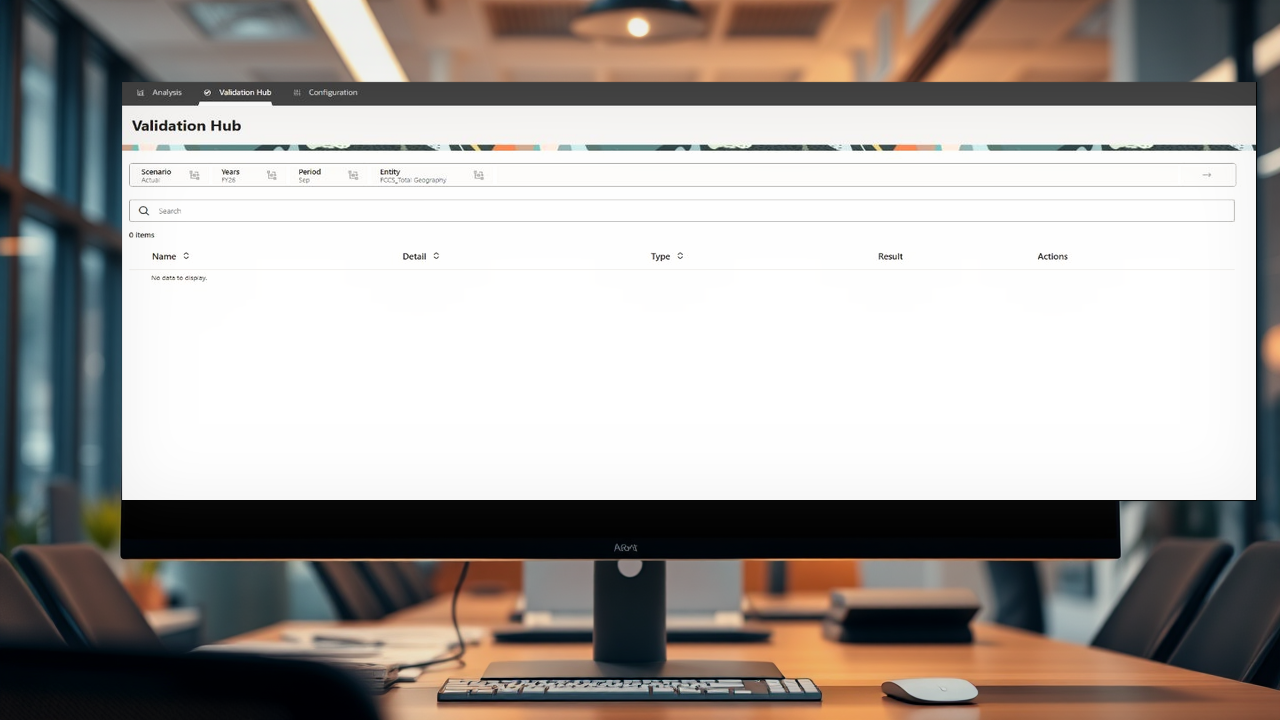
Oracle shipped the Validation Hub in August 2026, inside the Financial Analysis Hub. One gate: it exists only in the newer application type Oracle calls DSO. Not on that flavor? None of this exists for you yet; the rest is still worth the read.
Four kinds of checks live there: Out of Balance, which tests whether the balance sheet holds at the level you point it at; checks on acquisition and disposal movements and on consolidation statuses; and Custom Expression, which is yours. The first is the one most close cycles already rely on, and the one this article builds on rather than replaces.
Every rule carries an Activity Trigger: consolidation, translation, a data load or delete, or you pressing Run. Built-in checks fire on their triggers, asking nothing. Custom rules differ. A triggered rule runs on the point of view stored inside it. The POV is the slice of data a check looks at: one entity, one year, one period, one scenario. That stored POV needs a hand every close; the gotcha below prices it.
The silo, said once
A validation produces a page a person reads. Nothing outside the consolidation system can start one or collect its result. The validation is only as reliable as the person who looked, and the only proof anyone looked is whatever your team wrote down elsewhere. A green tick nobody examined and a red flag nobody had time to fix look identical in the certification pack.
That matters more than it sounds, because the checks are only as good as the consolidation feeding them. If your intercompany eliminations or NCI calculation are off, an out-of-balance result is the honest signal that something drifted. It just does not tell you where. Start with the consolidation pillars if any of those are new.
Custom rules: the part that makes this yours
A custom expression compares dimension members with a comparison operator. The operators go beyond Equal and Not Equal to Greater Than and Less Than; Oracle’s custom expression checks page hedges with “such as”, so treat that list as a floor. In practice you point the right-hand side at another member or fixed value; that’s observed in the product, not documented.
What that buys:
- Intercompany payable against intercompany receivable for a pair of entities, the same trade from both sides; if these aren’t Equal, someone’s counterparty booking is wrong.
- An entity’s revenue against its comparative-period revenue, where Equal is the healthy answer: the entity that loaded nothing, or loaded twice, breaks the match. For a live entity the numbers legitimately differ, so this is a completeness check on the comparative, not a revenue test. A real revenue test compares the figure against a control total or a plan member, not last year.
- A suspense or control account against a fixed constant; Greater Than zero on an account that should never be empty.
- A balance against its budget or forecast member in the same scenario, testing Not Equal against a zero control total, catching the division that never submitted its forecast.
What it doesn’t buy: a range, band or tolerance operator. No “within five percent of last year.” Need a band? Write two rules, floor and ceiling, both of which must pass. An absolute test is cheap: payable equals receivable or not. A proportional one isn’t; don’t fake it with a constant that holds at one entity’s size.
The ladder
Don’t validate once at the top; validate every level, the day that level is ready.
Days one to three: the lower levels. Checks run as the entities load and consolidate; the purpose isn’t sign-off, but finding the break while there’s still time to fix and rerun it. A failed check on day two is a work item. The same failure on day seven is an incident, four people on a call.
The middle: the division. Once the underlying entities are clean, the division validation asks a different question: does the rolled-up picture hold? This is where the inherited break gets caught, before it reaches the group. One division-only example: total intercompany payable against total intercompany receivable across the division’s entities. Every pair nets to zero inside the division, so a non-zero total is an orphaned balance, a trade booked against the wrong counterparty, or an entity consolidated with the wrong ownership share. No single entity can see that; the division owner can, as the first person with all the pieces in one place.
The last days: the top. By the group pass there should be little left to find. This rung supports the audit conversation, not the audit. It produces one volatile page a rerun can erase; what the auditor weighs is the attestation, what the owner wrote down in Task Manager.
The rival it has to beat. Most closes already rely on the usual approval steps, the intercompany matching report, and one hub pass at group level; for pure intercompany breaks, that’s enough. Non-intercompany, the group pass catches the same classes, days later. What the ladder buys is timing, ownership and the preventive gate, not a class the existing design can’t see.
Task Manager makes each rung a task for whoever owns that level: the entity accountant, the division controller, the group close lead. Each task carries a hub link and a written point of view: scenario, year, period, entity. The link only opens the hub page; the written POV is the reviewer’s guide, so confirm the page’s selector matches before reading green as green. Outcome goes in the task, then it closes.
On red. Nothing on Oracle’s pages prescribes a red path; this is practice, not product. When a check fails, the level’s owner and the close lead hear about it the same day. The red blocks the level above from signing, which is what Prevent Task Approval exists for. One caveat: what clears that block once the reviewer responds is documentation-implied and untested; verify before building a close calendar on it. If the calendar forces sign-off, approve only with the red’s disposition recorded; a silent approve is the failure this design exists to prevent.
Gotchas that break the ladder
The timing window. Consolidation and translation triggers fire on Impacted (changed, not yet processed); numbers are trustworthy only once the status settles to OK (processed, settled), per Oracle’s prerequisites for reading results page. Schedule each review after the settle.
The failed rerun. A failing rerun deletes the previous result and leaves nothing. Rerunning against a POV from earlier in the close can take the earlier evidence with it, so note the outcome in Task Manager before you press the button.
POV recurrence, the real cost. A hand-run configuration takes a POV you pick at run time. A triggered one runs the POV stored inside it (see Managing Financial Analysis Configurations); no bulk roll-forward is documented. The owner re-points it every close: duplicate last period’s configuration rather than edit in place, which deletes the previous close’s output. Once per rung, per close, by hand.
Parent and child are separate, and so is every entity. A check names one entity. The POV’s Scenario, Year and Period accept formulas, but the Entity does not, so one configuration covers one entity and a parent check does not validate the children beneath it. A three-level ladder is therefore a set of configurations, and the entity rung is the expensive one: one per entity, each POV re-pointed every close. That is the arithmetic behind putting the custom checks at division and group only. The entity rungs are carried by the built-in checks, which need no maintenance.
Out of Balance is worth understanding before you lean on it. It confirms the balance sheet articulates at the level you selected, which is the first thing anyone signing a close wants proven, and often the only thing the built-ins need to give you. It does not tell you which entry broke it, so treat a clean result as necessary, not sufficient.
Visibility. Application security decides who sees what; a reviewer with no access to an entity sees an empty page that reads as “no exceptions” to anyone in a hurry. Check each reviewer can see their level before day one.
When the close slips. A late level moves its rung with it. A compressed close is not graceful: it hands every reviewer a stack of checks nobody read, and attesting that stack in one sitting is the single-top-pass failure again. The red path covers a check that ran and failed; an unreviewed rung is different and gets cancelled in Task Manager with the reason recorded, not batch-attested. The cancellation is what the gate sees; never cancel quietly to keep the calendar moving.
Where this is going
Honest position: the ladder works because people do the looking, every rung, every close. That’s also its weakness. It goes obsolete the day the hub’s result is something the close can act on by itself, a level blocked on the check rather than a person’s word. If Oracle closes that loop, I pull this and replace it with a shorter, better one.
The takeaway
The ladder’s principle fits in one breath: each check happens where the numbers are owned. Each result belongs in the hands of the person accountable for it, at the level that person can actually fix. Each sign-off should leave a record of what was reviewed, at which point of view, and what the reviewer found. That is how validation stops being another page someone remembers to visit and becomes part of the close.